
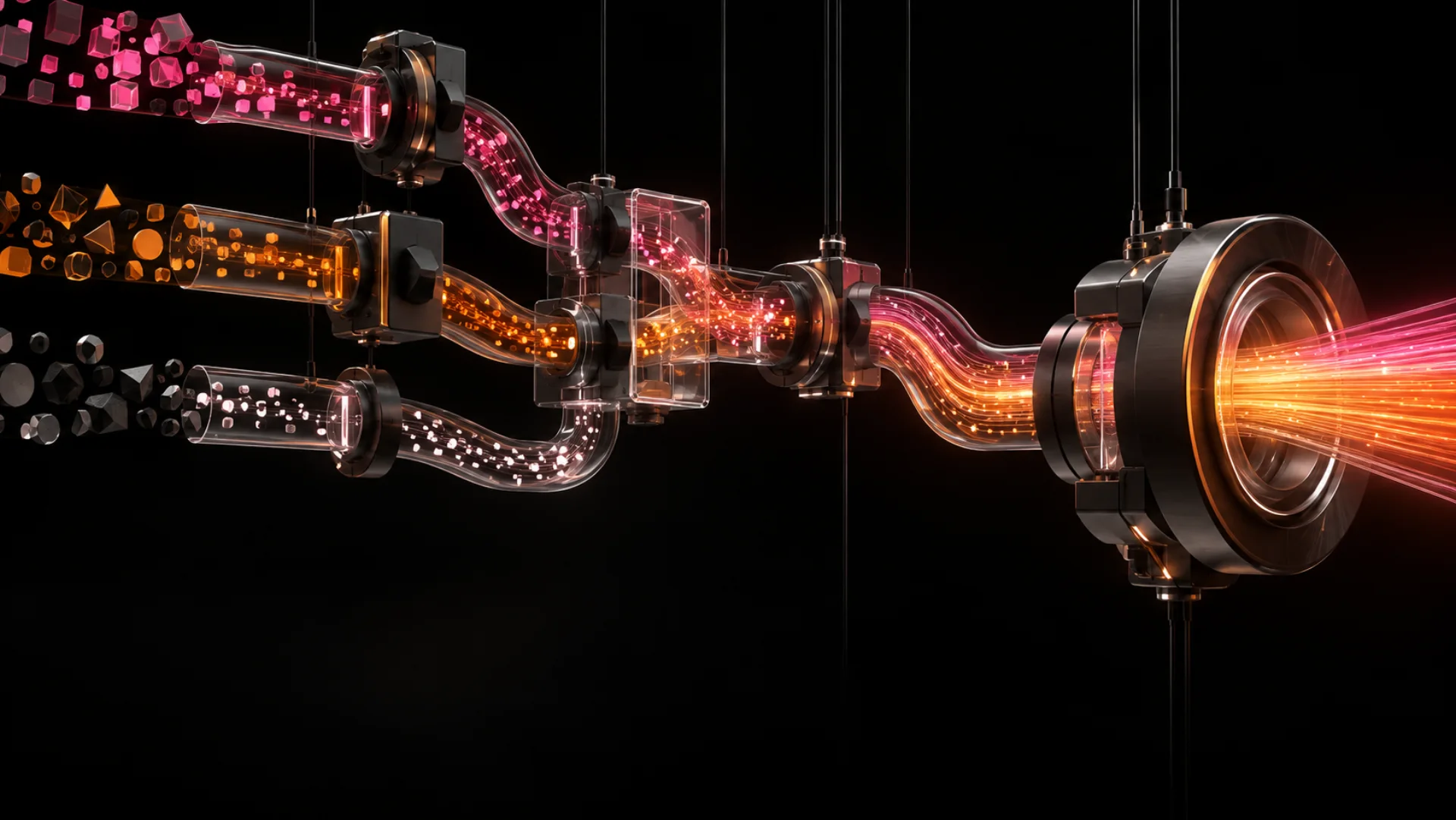
Fragmented inputs converging through a clear automated pipeline in Enginecy pink and orange

AI agents & automation

Make repetitive work disappear.

We design practical AI systems that connect your tools, organize your knowledge, and handle the work that slows good teams down.

Find your use case

The opportunity

Automate the friction, not the judgment.

The best AI implementation is not a novelty layered onto broken work. It is a carefully designed operating system that removes repetition while keeping people in control of decisions that matter.

  1. 01

    Where does work stall?

    We map handoffs, duplicate entry, missing context, and the repetitive steps consuming your team's attention.

  2. 02

    What should an agent know?

    We structure the data, policies, examples, and permissions required for dependable output.

  3. 03

    Where must a person decide?

    We define review points and guardrails so automation supports judgment instead of obscuring it.

  4. 04

    How will value be measured?

    We connect each workflow to time saved, response quality, throughput, or another observable business result.

02 / Where work leaks

Three places the work falls through.

01

Capture and intake

A form arrives at 9:47pm. If the first reply waits for Tuesday morning, someone else has already answered, quoted and booked. We score inbound inquiries against your criteria, answer immediately, and pass the ones that deserve a person straight to a person.

02

Workflow and operations

Close a deal and the contract goes out, the calendar blocks the onboarding call, and the invoice is logged, in that order, without anyone retyping the same details into four systems. We connect the CRM, calendar, inbox and reporting you already pay for, usually with n8n.

03

Follow-up and retention

A prospect books and does not show. Instead of dropping off the radar they get a message, a reschedule link, and a second touch days later if they stay quiet. Every stage gets a sequence written for where that person actually is.

Detailed automated workflow transforming fragmented work into a clear output

Messy inputs. Clear logic. Work that moves without waiting.

What we build

AI shaped around the way your business works.

01

Workflow design

Opportunity audits, process mapping, solution architecture, data requirements, and human review points.

02

Agents & assistants

Research, content, support, sales, and operations agents grounded in your knowledge and rules.

03

Connected automation

Integrations, triggers, routing, approvals, monitoring, and documentation for a system your team can operate.

04 / The method

How a system gets built.

  1. 01

    Process mapping

    We walk through how the business runs today, every handoff and every tool, and mark the points where work waits on a human who is busy elsewhere.

  2. 02

    Workflow design

    The blueprint comes before the build: what triggers what, which systems talk to each other, where a person reviews, and what handled means for each type of request.

  3. 03

    Build and integrate

    We connect the CRM, calendar, email and site into one system, using the tools you already have rather than asking you to replace them.

  4. 04

    Test the edges

    Every trigger and edge case gets exercised before a real customer touches it, including the ones that only happen once a month.

  5. 05

    Monitor and adjust

    We watch what the system does after launch, catch silent failures, and change the workflow when your process changes.

05 / Questions

Common questions about automation.

Do I need a big tech stack for this to work?

No. Most of what we build runs on what you already have, whether that is GoHighLevel, HubSpot, a shared inbox or another CRM. We connect what is there before recommending anything new.

Will this replace my team?

No. It removes the part of the job that is copying the same record into three systems, which gives that time back for conversations with people who already had a same-day reply.

How is this different from a Zapier setup we could build ourselves?

Zapier is fine until a workflow needs to branch, with different actions for a hot lead and a cold one. Most do-it-yourself setups either cannot handle that or fail silently when they do. We build on n8n and monitor it, so a broken trigger is caught in hours rather than discovered weeks later.

How long does it take to see a difference?

Lead-response automation is usually live within days and the change in response time is immediate. A full intake-to-close system takes longer, and we scope the real timeline on the mapping call.

What happens when our process changes?

The workflow gets updated. This is not a set-and-forget build: we monitor it and adjust as the business changes.

Do you write the follow-up messages, or just build the triggers?

Both. We write the sequences as well as the plumbing, so automated follow-up still sounds like it came from your business.

Start with the workflow

Give the busywork
somewhere else to go.

Get in touch